Port Aransas: an island town built on tourism, fishing and marine science
Port Aransas is the only established town on Mustang Island, and its economy runs on visitors. Tourism is the largest part of the local economy, and the summer population can swell to 60,000 or more against a 2020 Census count of 2,904 residents. That gap tells you what the commercial building stock looks like: hotels, condominium towers, rental properties, restaurants, bait and tackle shops, marinas and retail along the island roads.
Fishing has always been a staple here, especially sport fishing for spotted seatrout and redfish. The town is also home to the University of Texas Marine Science Institute, a research campus that dates to 1941, and to some of the oldest buildings on the coast, including the Tarpon Inn, built in 1886 and listed on the National Register of Historic Places in 1979.
Getting to the island matters for anyone who maintains a building here. TxDOT runs the Port Aransas ferry between Aransas Pass and Mustang Island free of charge, 24 hours a day, weather permitting. The other route runs down Padre Island and up Mustang Island. Either way, the island is a place where a roofer should arrive with a plan and the right materials on the truck.
What salt air, Gulf wind and island sun do to a Port Aransas roof
A roof in Port Aransas is exposed on every side. There is no tree line and no inland buffer between the building and the Gulf. That shows up on commercial roofs in a few predictable ways.
Salt and metal. Salt-laden air settles on fasteners, metal edge, coping, rooftop unit curbs and metal roof panels. Over time it attacks exposed steel and anything that was not specified for a coastal site. Corrosion at a fastener or edge detail is often where wind gets its first grip.
Wind at the edges. Gulf wind loads hit hardest at roof perimeters and corners. Loose edge metal, lifted flashing or a tired seam on a single-ply roof can let wind get under the membrane.
Sun and heat. Long, hot summers cook sealants, caulks and coatings. Sealant that looked fine last year can shrink and crack, which opens a path for wind-driven rain.
Sand and debris. Blowing sand and storm debris collect around drains, scuppers and gutters. On a low-slope roof, a blocked drain means standing water and added weight.
Port Aransas storm history that shaped how roofs should be maintained
Port Aransas has been rebuilt more than once. The 1916 Texas hurricane destroyed the town except for a few buildings, and the 1919 hurricane destroyed the main structure of the Tarpon Inn.
Hurricane Celia, August 3, 1970. The National Weather Service in Corpus Christi records a maximum gust of 127 mph at the Port Aransas Coast Guard station and a storm surge of 9.2 feet on the beach. About 75 percent of homes and businesses in Port Aransas suffered damage, and the NWS notes the surge caused only minor damage there. In other words, wind did most of the work.
Hurricane Harvey, August 25, 2017. Harvey made landfall as a Category 4 hurricane, first on San Jose Island and then near Rockport and Fulton. The Port Aransas sentinel station recorded a peak gust of 132 mph. The University of Texas reported that several buildings at the Marine Science Institute, including the Estuarine Research Center, the administration building and the Fisheries and Mariculture Laboratory, had extensive damage from roofing failures and water penetration.
Hail, November 1, 2025. A trio of supercell storms crossed the Coastal Bend, and Texas Parks and Wildlife reported 3-inch hail at Mustang Island State Park, on the same island as Port Aransas. KRIS 6 noted the event could be the largest hail in Nueces County history. Hail of that size can bruise insulation, crack membranes and dent metal without showing an obvious leak right away.
Hurricane season runs June 1 to November 30. The lesson from this history is simple: the time to find a loose edge or a failing seam is before the season, not after the storm.
What a Port Aransas commercial roof maintenance program covers
A commercial roof maintenance program is a written, repeating plan of inspection and upkeep for a specific roof. On the island, we build it around the conditions above.
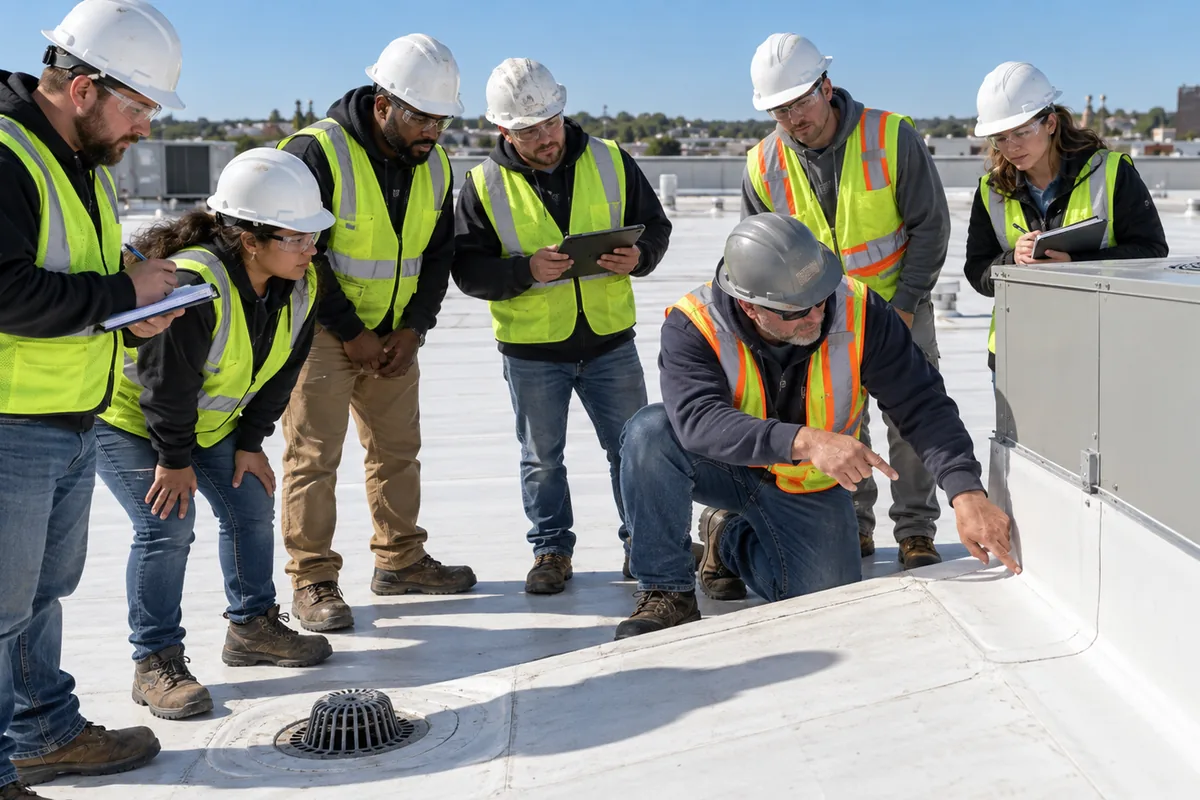
Inspection with photos and written findings. Every visit ends with photos and a plain-language report of what we found, so the owner or property manager has a record, not a guess.
Salt-air fastener and metal checks. We look at fasteners, edge metal, coping, rooftop equipment curbs, metal panels and lightning protection components for corrosion, looseness and movement.
Perimeter and seam checks. We check membrane seams, corners and perimeter attachment on TPO, PVC, EPDM and Duro-Last roofs, where wind uplift starts.
Drain, gutter and debris clearing. Sand, shells, bird debris and storm trash get cleared from drains, scuppers and gutters so water leaves the roof.
Seam, flashing and sealant touch-ups. Small repairs on small problems, before salt, sun and wind turn them into big ones.
Pre- and post-storm checks. A walk before hurricane season and a walk after any named storm or hail event, with photos for your file.
Where a roof is aging but still sound, a silicone or metal roof coating may extend its service life. Where it is not, the program helps you plan a replacement on your schedule instead of the storm's.
Port Aransas commercial roof maintenance schedule
| When | What we check |
|---|---|
| Spring, before June 1 | Full roof inspection with photos, edge metal and fastener corrosion, seams and corners, drains and scuppers cleared, sealant and flashing touch-ups before hurricane season |
| Fall, after November 30 | Post-season walk for wind and salt damage, seam and flashing condition, coating wear, debris and sand removal, update of the roof file and budget |
| After any named storm or hail | Post-storm check for lifted membrane, displaced edge metal, hail bruising, punctures and blocked drains, with photos for your insurance file |
| Every visit | Photos and written findings, drains and gutters cleared, rooftop equipment curbs and penetrations checked, lightning protection components looked over |
Roof management as asset management for island properties
For a hotel, a condominium association or a research building, the roof is one of the largest assets on the balance sheet. Managing it like an asset is standard practice in facility management.
Keep a roof file. Roof type, age, installer, warranty, past repairs and inspection reports in one place. That file is what an adjuster, a buyer or a board will ask for.
Use photo logs over time. The same views, photographed visit after visit, show whether a seam or edge is getting worse.
Budget on condition, not on emergencies. A roof that is inspected on a schedule gives you warning. That lets you plan repairs, coatings or replacement years ahead and spread the cost.
Plan around the season. On the island, the best time for major roof work is outside the heart of hurricane season and outside the busiest tourist weeks.
Windstorm, TWIA and roof records in Nueces County
Nueces County is one of the 14 coastal counties in the Texas Windstorm Insurance Association designated catastrophe area, so TWIA rules apply to Port Aransas.
TWIA states that replacing a roof or repairing a significant portion of a roof requires a windstorm Certificate of Compliance (WPI-8) from the Texas Department of Insurance. TWIA generally requires a certificate on file for a property to be eligible for coverage. Temporary repairs after a storm do not need a certificate.
That makes records part of roof management. Keep copies of certificates, inspection reports and repair invoices in your roof file. This is general information, not legal or insurance advice. Check with your insurance agent about your policy and what your carrier needs.
How Nelson Roof Contracting manages roofs in Port Aransas
Nelson Roof Contracting works from 5233 IH 37, Ste. C-15, in Corpus Christi. Port Aransas is about 32 miles away by way of SH 35, SH 361 and the free ferry from Aransas Pass, or about 40 miles by way of Padre Island and Mustang Island.
We bring over 50 years of hands-on roofing experience and more than 30 million square feet of roof systems installed. Every job is supervised, and our crews are 100% in-house. We are a certified Duro-Last installer, and we install TPO, PVC, EPDM and Duro-Last single-ply roofs, metal roofing, silicone and metal roof coatings, and UL-approved lightning protection.
Our services cover inspections and maintenance, repair, replacement, coatings and storm damage. The office is open Monday through Saturday, 8am to 5pm, at (361) 683-1733. Our 24/7 line, (361) 320-3131, is answered day or night. You can also email roofcontract@yahoo.com.
Sources
- Port Aransas, Texas (Wikipedia)
- Port Aransas ZIP code and 2020 Census place data (zip-codes.com)
- Port Aransas Ferry (Port Aransas Chamber of Commerce)
- Hurricane Celia 1970 (NWS Corpus Christi)
- Hurricane Harvey 2017 (NWS Corpus Christi)
- Update on extensive damage to Marine Science Institute (UT Austin News)
- How rare is baseball-sized hail in the Coastal Bend (KRIS 6)
- TWIA overview and coverage area
- TWIA windstorm certification
- NWS Corpus Christi 2026 Hurricane Guide